Strategy development processes can be internally or externally facilitated. The word is facilitated. The role of an internal facilitator may be straightforward but this is not often the case for external facilitator, or if you like a consultant. Different organizations and leaders will have different preconceptions on the role of an external facilitator; with some assuming that the facilitator should lock themselves in a room and come out with a strategy document, others thinking that they should work out a miracle that resolves all the problems that they have all along been aware but are reluctant or are unable to solve, and yet others behaving as if it is a competition as to who between the leader and the consultant knows more and must have their ideas prevail.
While some of these notions are downright absurd, the leaders and organizations that benefit most from external facilitation are those who view the external facilitator as a partner, and yes a facilitator. In other words, the external facilitator or consultant walks alongside the leadership team charged with the responsibility of formulation of the strategy in a co-creative manner. The leadership team must be willing to present their views, good or not so good, raw and processed ones, or even the abstract and practical. Granted, the consultant should be experienced, has wide exposure and ideally adequately versed in the particular field but most importantly has a knack for sieving through the noise to the strategic issues out of all the discussions that emerge.
The consultant will then critically consider the team’s inputs, enrich it with their wide experience and deep knowledge and pollinate these through strategic questioning. The goal is to elevate the leadership discussions, foster insight and collaboration, and unlock the full potential of the organization. The results should be thoughts and plans that are full of foresight but moderated by specificity, measurability, attainability, reality, and implementable within the bounds of time.
But one may ask, what in the world is the worth of engaging an external facilitator if, after all, they will not give us the strategy? Here are my five C-sense reflections on this question:
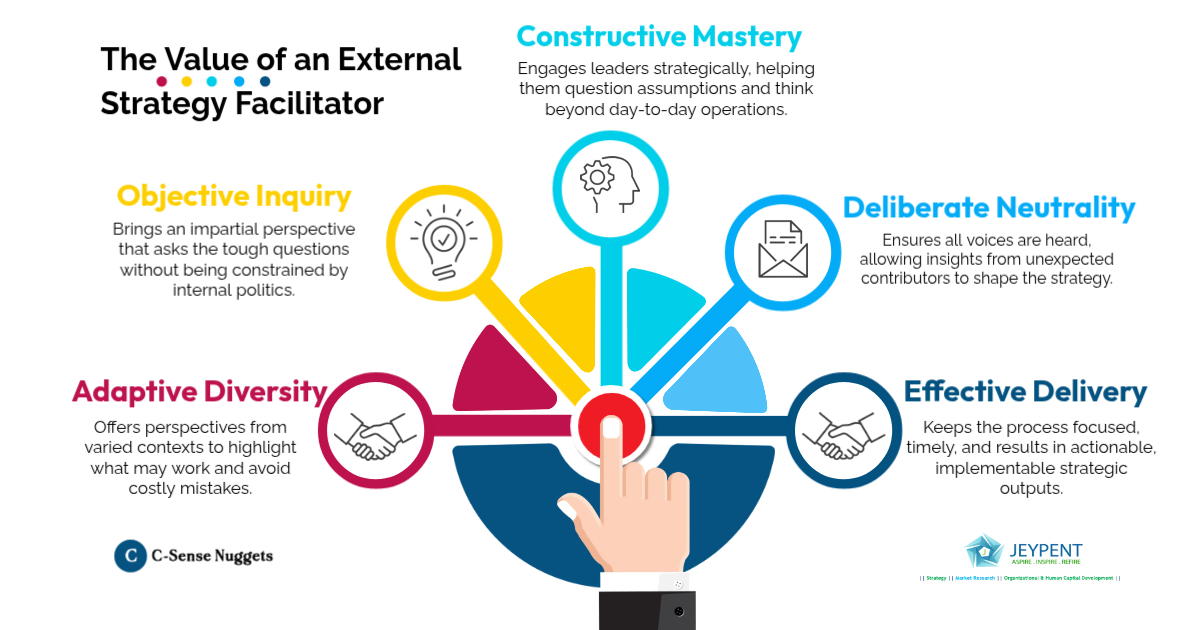
- Constructive mastery: It is expected that an external facilitator should have a fair grasp of the organization’s business focus. This does not in any way mean that the facilitator needs to know everything and anything that the organization deals in but they should demonstrate an adequate level of understanding as to strategically and constructively engage with the leaders, and their business that would elicit deeper thought and questioning of past assumptions in ways that are constructive than they would ordinarily do without an external facilitator’s guidance. Of all mastery, the most strategic for an external facilitator is the capacity to remain strategic even when the discussions are shrouded by the tactical and operational as the day-to-day implementers argue out their positions.
- Objective inquiry: An external facilitator brings an outsider view that is often free from the organizational shenanigans. An objective perspective can be incredibly helpful to an organization that seeks to question status quo and is willing to adapt as its operating context evolves. They can ask the hard questions without being conflicted by organizational hierarchies and regressive allegiances.
- Deliberate neutrality: The external facilitator exercises deliberate neutrality ensuring that all voices are heard equally, and personal agenda are overridden by the organizational good. Discerning and issues-focused leaders, in a strategy development process, benefit from this aspect of a facilitator by receiving constructive inputs from unlikely sources, often employees, customers and partners who would ordinarily avoid speaking or contributing because they either consider themselves too low on the ladder or their ideas not good enough.
- Adaptive diversity: An external facilitator will likely bring diverse experience and exposure from different and/or comparable contexts. They then view and contribute to the strategy development processes through a balanced and adapted lens. The adapted perspectives benefit the organization by presenting options on what may work and what may not work hence cushioning it from learning from its own mistakes while building on tested foundations.
- Effective delivery: It is so easy for strategy development processes that drag for unnecessarily long periods before conclusion. The biggest contributor to such protracted processes is often the fact that every person within the organization has a full-day job to attend, whether it is strategic or not, notwithstanding. Left to themselves, the leaders in an organization may never create time that would be adequate to process stakeholders’ contributions, consolidate these into appropriate frameworks and document the actions into implementable plans. With an external facilitators, their day-to-day work is seeing to it that strategy development processes end up successfully with a document that can guide strategic execution being one of the key outputs. While this may appear to be such a common-sense issue, the experience with many organizations is that it is not.
Like many other issues in life, it is not guaranteed that your next external facilitator will embody all the five qualities covered in this C-sense reflections piece. It is therefore important to know what you would need to look out for when selecting an external facilitator for a strategy development process. The truth is, good external facilitators are well worth their wage.
Which of the points in this reflection do you agree or do not agree with?