In the my last piece, I shared my reflections on why the strategy process is more if not equally important as the product (the strategy itself). I underscored that of all the aspects to consider about the strategy development process, making it participatory is most definitive.
But just how does an organisation and its leadership make the strategy development process participatory?
Psychological safety, in this case, refers to the ability, willingness and likelihood of the stakeholder to express themselves without fear of reprisal. If an organization aims for an objective assessment of its situation which will then inform its strategic options, it had better be ready to hear the good, and the bad, the beautiful and the ugly, the comfortable and the unsettling from its stakeholders.
Broadly, the stakeholders will be internal or external to the organisation with specifics of each category being dependent on the type of organization (e.g. for-profit vs. non-profit, local vs. regional vs. international, private vs. public, small vs. large, among other considerations).
Stakeholder engagement channels
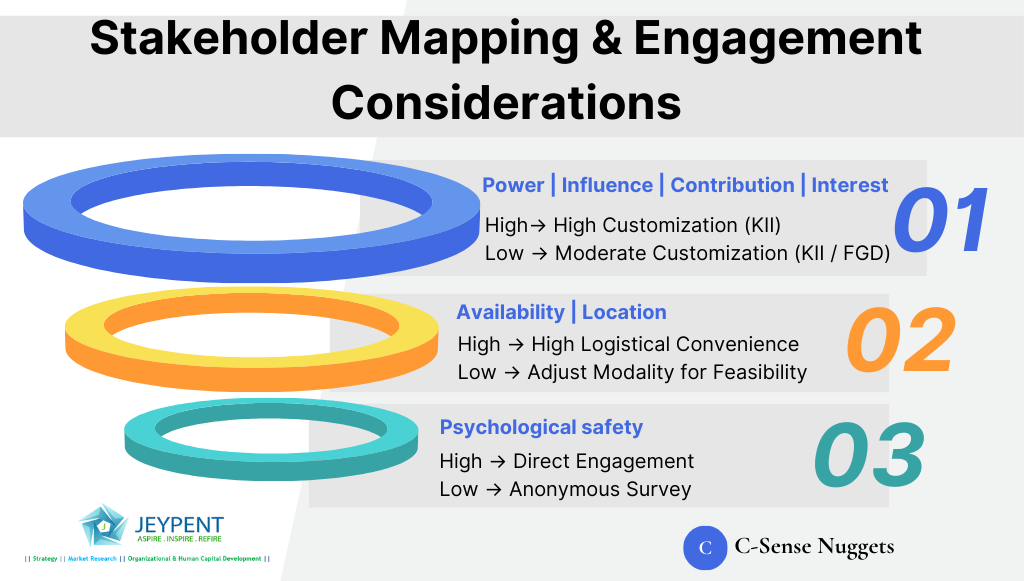
Having determined who needs to be engaged in the strategy development process in their broad and specific categories, the next important consideration will usually be the engagement channels. The interests, contributions, influence, potential impact and most critical, the psychological safety of the stakeholders are the important considerations that are helpful in determining the channels to use.
In addition, the location, availability and convenience of the stakeholder is a critical determinant of the channel to use. Table 1 shows my C-sense approach in mapping stakeholders for engagement in a strategy development process bearing in mind the various considerations mentioned in this article.
Table 1: C-sense approach in mapping stakeholders for involvement in a strategy development process and appropriate engagement channels
| Level of consideration | Consideration | Rating (H=High; L=Low) | Nature of Channel | Example of Channel |
| Primary | ¨ Power
¨ Influence ¨ Contributions ¨ Interests |
H | Highly convenient, personal and customized | KII (remote or in-person) |
| L | Less customized even if H in Secondary consideration | KII or FGD (remote or in-person | ||
| Secondary | ¨ Availability and Location’s convenience
|
H | Less customized subject to primary considerations | |
| L | Highly convenient if H in primary considerations | |||
| Overarching | Psychological Safety | H | Low anonymity | |
| L | High anonymity | Anonymous online survey |
Caption: Table 1: C-Sense Approach in mapping stakeholders for engagement
Key:
A closing C-sense note:
Often, it’s not those who sing of an organization’s praises that are able to move it forward but those who may come out as critical, skeptical, and discontented with status quo. As a strategic leader, one must learn to allow key stakeholders to have their say even if not their way. Leaders who aim to make their organizations better and competitively position them must be ready and willing to provide a safe space for all voices to be heard, and grow their capacity to objectively pick constructive contributions while soaring above destructive energy.