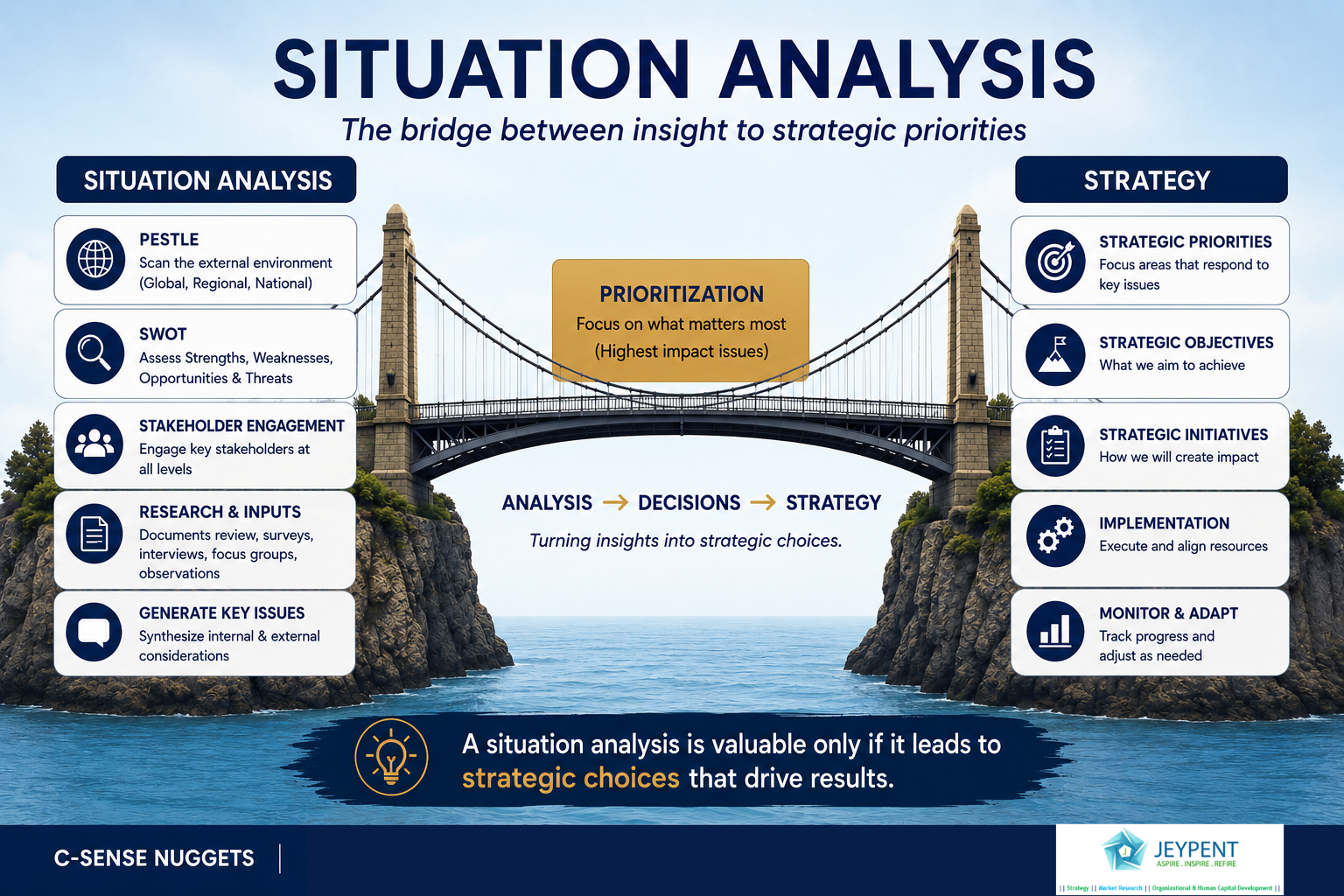
So, how do you ensure that your situational analysis actually informs strategy?
In the previous piece, I noted that many situational analyses do an excellent job of describing an organization’s operating environment but fall short of informing strategic choices.
Over the years, I have found that useful situational analyses tend to have a few things in common.
Regardless of the tools one uses for the situation analysis, here are the key C-Sense nuggets I propose for carrying out a useful situation analysis:
- A funnel approach for the external analysis: Consider the global, regional, and national issues impacting your organization’s issues and for each include what should be the strategic response. The Political, Economic, Social-Cultural, Technological, Legal-Regulatory, and Environmental (PESTLE) factors framework, among others, is often useful to conceptualize your analysis.
- Use the Build on, Eliminate, Exploit, and Mitigate (BEEM) approach to respond to your organization’s Strengths, Weaknesses, Opportunities and Threats (SWOT). Think about how you will build upon each strength, how you eliminate each of the weaknesses, how you will exploit each of the opportunities, and you will mitigate or minimize the threats. This will help to not merely describe the strengths, weaknesses, opportunities and threats but more importantly, the strategic response to each.
- Use multiple approaches and engage the key stakeholders to generate the key situational issues. Internal and external documents reviews, online surveys, key informant interviews, focus group discussions, and observations are useful approaches to derive the key issues for an organization’s situation. The lower level staff and clients of organizations are some of the most neglected stakeholders in many strategy development exercises. While strategic planning may be the realm of the board and senior leaders of the organizations, strategic inputs can and do emerge from any level of the organization.
- The analysis of both internal and external issues is likely to generate a myriad of issues. Strategy development entails a determination of both what to focus and what not to focus on. It is therefore important to synthesis the outputs and determine what the key priorities of the organization out of the situation analysis will be. What strategic responses to the PESTLE and SWOT analysis will the organization prioritize over the next strategic plan period?
- Finally, use the outputs of the situation analysis to generate your strategic priority or focus areas for the next plan period. While this sounds obvious, it is interesting that looking at many strategic plans reveals a disconnection between the two. The situation analysis appears to be an exercise that is done to tick the box and occupy a section of the document because it is often loosely connected to the identified strategic priorities of the organization for the plan period.
If the organization’s strategic priorities for a particular period are not related to its strengths, weaknesses, opportunities and threats and do not respond to the identified external environment issues, then it is likely that either it is shooting in the dark or the situation analysis exercise was not worthwhile.
As nugget (iv.) suggests, it is not possible to cover all the generated issues so the leadership needs to strategically apply itself to determine which issues if addressed will confer to the organization the highest multiplier effect and throughput towards its strategic objectives.
In conclusion, a good situation analysis is not just descriptive but analytical, that is why it is called an analysis. The worth of the situation analysis is how its outputs inform not just the organization’s focus areas within the plan period but how these are prioritized to make them truly strategic.
What are your thoughts and observations on a good situation analysis and its worth in strategic planning? Which of my C-Sense nuggets do you agree or differ with?