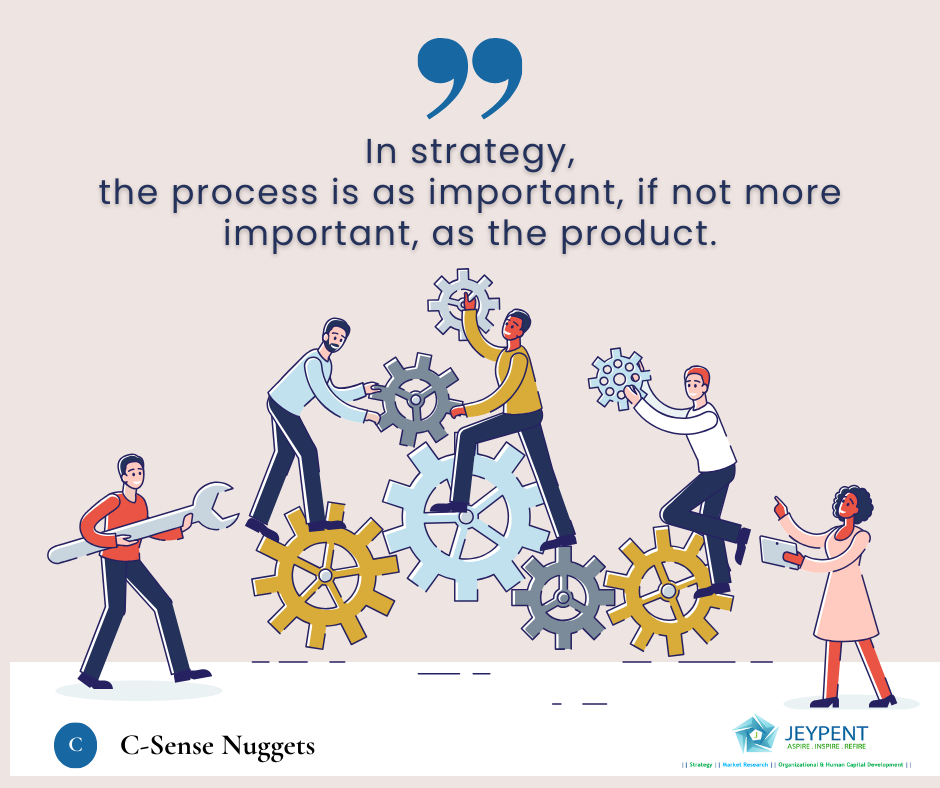
The planning process is perhaps the most strategic aspect of strategy development. This sounds so basic but my 10+ years of strategy facilitation proves that it is not. I have lost count of leaders and organizations that imagine that the Board, or the Senior Management or the Consultant can lock themselves in a room and a few hours or days voilà! come up with an effective strategy. Nothing could be further from the truth. Fast? Maybe; Successful? Almost always not!
A process that is participatory, inclusive, open and one that seeks to “leave-no-key-person behind” is central to successful strategy development. Here are my C-sense reasons to back-up my suggestion:
- Operating contexts for organizations are volatile, uncertain, complex and ambiguous. The only constant seems to be change. Even the best of plans made with the most accurate data by the most competent persons may still fall short once the environment shifts. A good strategic planning process should provide a safe ideation platform, entertain divergence and assume the best, normal and worst situations. Investment into a process does not assure that the future will be linear but guarantees that the changes or detours from planned scenario are easier to notice before or even as they emerge. Contingency measures can then be deployed effectively.
- It is people who make or break the strategy. The implementation of strategies requires the approval, buy-in, ownership, and goodwill of the implementers and all stakeholders at large. The people become the daily support and defence of the strategy’s implementation. The process affords an opportunity for all voices to be heard. The people must have their say even if not their way. Good ideas must give way to better and the best ideas. The process should enable and encourage engagement; engagement begets ownership; ownership begets investment; investment begets ambition, drive, creativity and most likely success as initially envisaged or even in a different pathway.
- No one has a corner in the knowledge economy. Strategic thinking can emerge from any level of the organization. Organizations and their leaders should encourage and facilitate participation from all key stakeholders. Experiences, knowledge, practical wisdom and insight from a broad range of stakeholders help to enrich the base from which strategic decisions are made. The participation of diverse stakeholders will save the organization from dangers that may emerge from groupthink. Even those who may come out as critical and down-right outrageous may be instrumental in seeing the other side of issues which ultimately helps to make well-calculated moves.
- When facilitated effectively, the strategic planning process provides a unique opportunity for strategic thinking especially to people who are often immersed in the operational and tactical, and rarely in the strategic. For discerning and deliberate leaders, it is an opportunity to identify talent, creativity and drive from amongst the team that will be champions for successful implementation of the strategy. It separates the status quo-minded team members to those who are raring to see constructive changes within the organization; those who are stuck with the box and those who are ready to kick it and act without.
Dwight Eisenhower, the 34th President of the United States of America said that “Plans are worthless, planning is everything”. While the four reasons given above may not have been what was in his mind, they support his thinking in many ways.
If you wish to learn more about strategy development and strategic leadership, check our training calendar HERE and/or invite us to train your team at a time and location of your convenience. We also have facilitated 50+ organizations (for-profit, non-profits, public, private, small, large, local, and international) in strategy development and strategic planning; we would love to facilitate yours too. Contact us via info@jeypent.com or +254707583477